


Information about the study
Here you can find out everything again in detail

Thank you for taking the time to learn more about our study.
To help you understand what to expect, this page provides a detailed overview of the Edu:Social Health Care project. We will guide you through the research design, the intervention process, the planned surveys, and our data protection concept.
Our goal is to show you transparently how the study works, what the time frame looks like, and how we protect your data – so that you can make an informed, relaxed, and well-founded decision.

The Edu:Social Health Care Project
Edu:Social Health Care is investigating the effectiveness of an eight-week online training program based on neuroscience that aims to sustainably strengthen the socio-emotional skills, mental health, resilience, and social cohesion of students across different professions at Paracelsus Medical University (PMU).
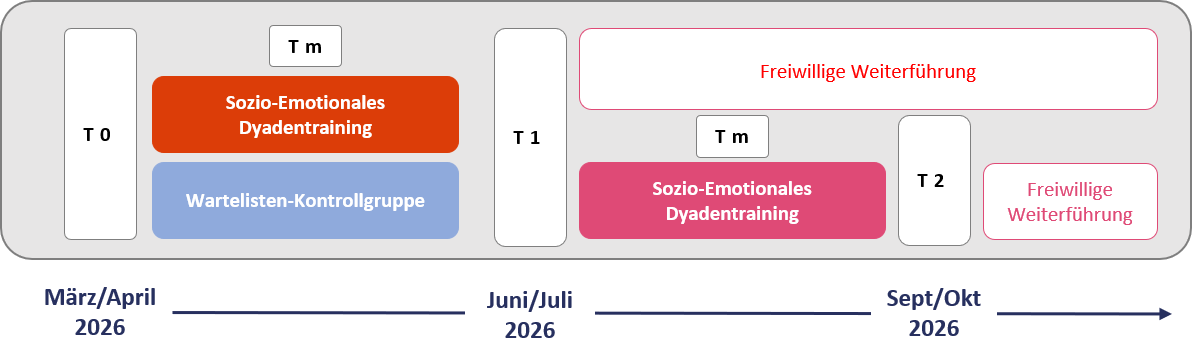
The training is embedded in a randomized controlled study design and comprises two groups: the active training group (“EMCO,” empathy and compassion training) and a waitlist control group (“WCG”). In order to reliably record changes, three central measurement points are used: a pre-test (T0), a mid-test at half-time (Tm), and a post-test (T1) after completion of the eight-week training. The WCG receives the intervention following the EMCO period and is also re-examined in Tm and in the post-test (T2).
This provides a scientifically sound overall picture of how the training works—at the individual level, in social interaction, and in the specific context of health-related degree programs, as well as in relation to the many different professions at PMU.
The Intervention – Your Path to Mental Strength
Before the training begins, you will take part in two onboarding sessions that will give you a thorough introduction to the training concept and the app. These sessions will prepare you optimally for the weeks ahead.
Depending on your group assignment, the actual intervention will take place either from April to June (EMCO) or from July to September (WCG). It includes eight weeks of socio-emotional dyad training and weekly coaching sessions that guide you step by step through the process and support your personal development.
The intervention is based on scientifically established programs from the Max Planck Society’s Social Neuroscience Lab, whose effectiveness has been comprehensively proven in numerous studies (ReSource, CovSocial, Edu:Social School). Proven effects include:
Increase in life satisfaction
Improving mental health
- Strengthening social cohesion
Developing social skills (empathy, compassion)
Increase in resilience
Stress reduction
Reducing loneliness
The dyad exercise is a short, structured conversation between two people, in which they take turns speaking and listening. It lasts 13 minutes and takes place six days a week via the study app.
Procedure: The app guides you step by step through the dyad and indicates who is speaking and who is listening. The exercise begins with a short moment of silence.
Then you talk about the following topics in turn:
- A difficult or challenging situation from the previous day.
- Something you were grateful for that day.
Meanwhile, the person speaking focuses their attention on the physical sensations they perceive. The listener listens attentively to the experiences described without judgment.
Weekly partner change: Each week, you practice with a new student from your coaching group. The app automatically assigns partners and ensures that partners are not repeated.
The weekly 90-minute coaching sessions are conducted by experienced trainers and deepen the content of dyadic practice. Thematic focal points include:
- Body language
- Empathetic listening & dealing with difficult emotions
- The power of gratitude
- Social & mental patterns
- Shared humanity
Study surveys – HOW WE MEASURE IMPACT
In order to reliably investigate how and why the training works, we collect different types of data at several points in time. We combine validated psychological questionnaires, short computer-based tests, smart app-based short surveys (EMA), and completely anonymized voice analyses from the dyads (pitch, volume, intonation—no content recordings).
This multimodal survey strategy allows us to accurately map changes in mental health, resilience, empathy, compassion, and social cohesion – and is thus the scientific core of the study.
For your participation, you will receive an expense allowance of €10 per hour. The time commitment is divided into many short, easily planned units and varies depending on the study phase.
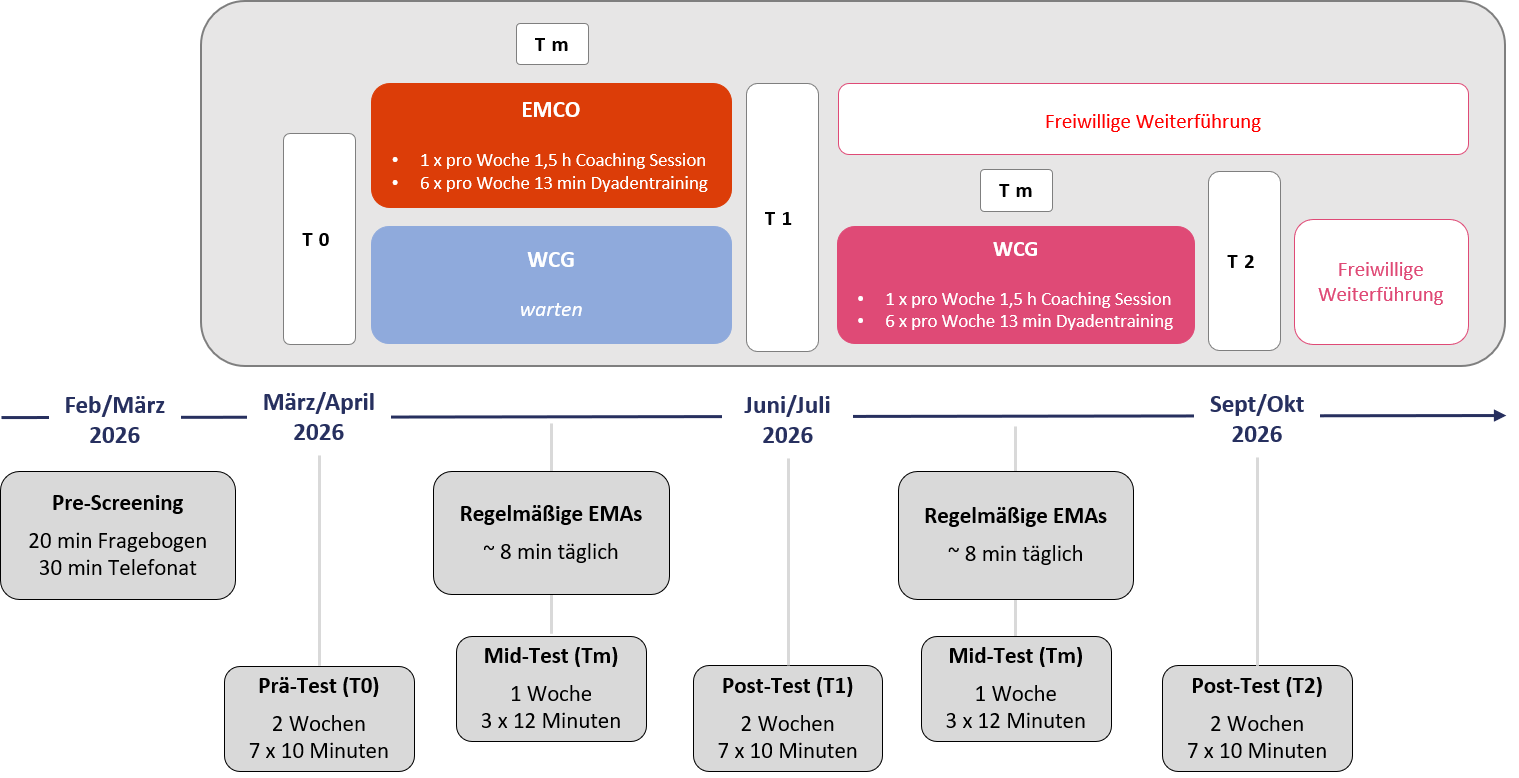
Before you can begin the study, the inclusion and exclusion criteria must be checked in the pre-screening to ensure that you are suitable for the study.
Online questionnaire to check the participation requirements
Short telephone conversation with a trainer to clarify questions, expectations, and availability
If you meet the pre-screening criteria, the eight-week training program will begin, depending on your group affiliation.
- Two onboarding sessions to introduce the structure, objectives, and techniques of the training.
- Weekly moderated coaching sessions in which experiences are reflected upon and background knowledge is imparted.
- Daily dyad exercises via the study app with partners that change weekly.
- Short pre-/post-dyad questions before and after each exercise to record immediate effects.
Surveys are conducted at several points in time to systematically record the effect of the training.
- Pre-test (T0): Recording of the initial level
- Mid-test (Tm): Takes place when the training transitions from empathic to compassionate listening
- Regular EMA surveys several times a week that reflect your current everyday experiences (stress, mood, social connectedness, etc.)
- Post-test (T1 / T2): Evaluation of the training effects
After the post-test, you can continue the dyad exercises via the app. Coaching sessions will no longer take place.
- Occasional short questionnaires accompany the voluntary continuation.
Data protection
The protection of your personal data is a top priority in the Edu:Social Health Care project. All data processing is carried out in accordance with the General Data Protection Regulation (GDPR) and the internal IT security standards of the Max Planck Society (MPG). All data is stored and processed exclusively on secure MPG servers in Berlin (MPI for Infection Biology, Charitéplatz 1, 10117 Berlin).
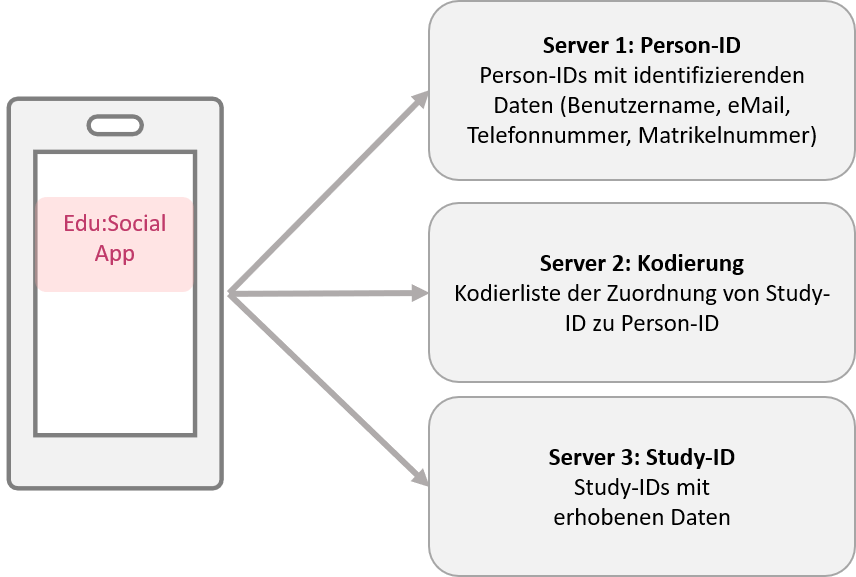
This is where the data required for registration is stored, which allows conclusions to be drawn about your identity (name, PMU email address, telephone number, student ID number). When you register, a personal ID is automatically generated. This randomly generated identification number is technically linked to this information and is also stored on Server 1. This means that this server only contains the personal data required for registration and technical administration of your participation.
Access rights:
Only the project coordination team at the Max Planck Society has access to Server 1. Scientists, trainers, or employees of the PMU do not have access to this identifying data.
Server 2 contains the coding list, i.e., the internal assignment between your personal ID (identifying data on Server 1) and your study ID (pseudonymized research data on Server 3). From a purely technical standpoint, this list enables subsequent re-identification, e.g., in the event that you withdraw your participation or wish to exercise your rights under the GDPR.
The coding list contains neither research data nor directly identifying data, but only the two numerical identifiers. Server 2 thus forms the central link in the pseudonymization process.
Access rights:
Only the project coordination team at the Max Planck Society has access to Server 2. Scientists, trainers, or employees of the PMU do not have access.
All research data collected during the study is stored on Server 3 – but only under your pseudonymized study ID. This ID does not contain any personal information and is completely separate from your identity data.
The study ID includes, among other things:
- Questionnaire data (pre-, mid-, and post-tests)
- EMA data
- Dyad pre-/post-ratings
- Data from computer-based tasks
Server 3 does not contain your name, email address, student ID number, or telephone number. It is not possible to identify you solely via Server 3.
Access rights:
The project coordination team at the Max Planck Society and the project’s research staff have access to Server 3. They work exclusively with pseudonymized Study IDs.