

Welcome to Edu:Social Health Care
FOR A HEALTHIER FUTURE IN THE HEALTHCARE SYSTEM
Healthcare professions are increasingly subject to high social, emotional, and structural pressure. Studies show that nurses, doctors, and other healthcare professionals are particularly at risk of developing exhaustion, loss of empathy, and symptoms of stress. At the same time, socio-emotional skills such as empathy and compassion, as well as social cohesion, are key resources for good interaction with patients and high-quality healthcare. This is where the Edu:Social Health Care project comes in.
The joint project between the Social Neuroscience Lab of the Max Planck Society (MPG) and Paracelsus Medical University (PMU) offers a unique opportunity to participate in an evidence-based socio-emotional online training program and, in just a few weeks, strengthen your personal well-being and social skills so that you are mentally prepared for current and future challenges in the healthcare sector.

Join in and discover how YOU can grow as a person.
WANTED:
Healthcare experts of today and tomorrow!
Are you a student at PMU and want to strengthen yourself mentally and socially?

Then join us—the program starts in early 2026.
Registration is now open and non-binding.

Key information about the study
The Edu:Social Health Care research study aims to support current and future experts in the healthcare sector and offers students of all PMU study programs and university courses free, evidence-based, eight-week training to strengthen their socio-emotional skills and resilience. These mental training programs have already been developed and scientifically tested with great success in many previous studies (ReSource, CovSocial, Edu:Social School projects) and have repeatedly demonstrated positive effects on resilience, mental health, and social interaction. They also promote tolerance for one another, social cohesion, and a deeper understanding of others.
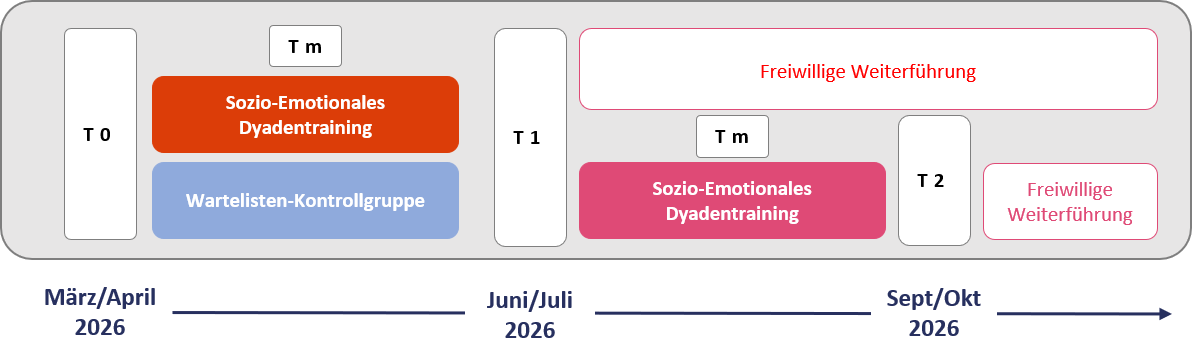
To train the “social brain,” the program—i.e., the study intervention—is based on daily, clearly structured 13-minute exercises that are performed via an app with a partner who changes weekly (random assignment of other PMU students). This so-called daily dyad practice is reinforced in weekly 1.5-hour online coaching sessions with trained coaches through short psycho-biological lectures, Q&A sessions, and small group exchanges.
In the research study—a randomized controlled intervention study with a waiting list control group—validated, standardized (short) questionnaires are used in addition to smartphone-based mini-computer tasks before (pre-test), during (EMA smartphone), and after the 8-week training program (post-test) to measure improvements in mental health, resilience, social skills, social cohesion, and attitudes toward interprofessionality.
Your participation at a glance
- 8-week app-based online training
- 13-minute partner exercises via app (once a day/six times a week) at mutually agreed times
- Free 1.5-hour online coaching sessions with certified intervention trainers (once a week)
- Financial compensation based on time spent (intervention group €110, control group €180)
- Flexible testing and surveys via app
Learn more live
Fancy a quick chat? (German session)
Join our digital info sessions! Here you will get a compact overview of the study and can ask any questions you may have.
The online events will take place from January 5 to February 13 and will last a maximum of 15 minutes:
- Monday: 2 p.m.
- Tuesday: 1 p.m., 4 p.m.
- Wednesday: 10 a.m.
- Thursday: 12 p.m., 3 p.m.
- Friday: 11 a.m.
Simply click on the button and let us know which date you would like to attend. We will then send you the WebEx link.
If you need an additional online appointment, you can also let us know—we will arrange it if possible.

The mission
More resilience and togetherness through mental dyad practice

People working in healthcare bear a high level of responsibility from an early stage. High work pressure, emotional stress, and regular contact with suffering mean that many struggle with the first signs of stress, exhaustion, or uncertainty even during their training. Studies show that prospective doctors, nurses, and pharmacists are particularly at risk of developing symptoms of stress, anxiety, or burnout.
At the same time, social and relationship-oriented skills are crucial in precisely these professions: remaining empathetic, regulating difficult emotions, acting professionally—and yet, and precisely because of this, being human. The Max Planck Society’s program specializes in training people how to shift from pure empathy to compassion in order to avoid empathic stress. Equally important is the ability to listen mindfully and compassionately without becoming overwhelmed or distanced.
This is where the Edu:Social Health Care project comes in.
An eight-week social-emotional online intervention is being used to investigate how structured daily dyadic practice—carried out via an app with exercise partners that change weekly—strengthens key protective factors: resilience, empathy, compassion, and social connectedness.
These skills have been scientifically proven to protect against excessive demands, loneliness, stress, and burnout, and form the basis for a healthy, sustainable career in healthcare.
Our mission is simple:
We want you to start your career in good health.
And we want you to learn to do for yourself what you do for others.
Working together for research
Become part of our innovative research
As a PMU student, you have the unique opportunity to participate in a research project that goes far beyond individual experience. In the Edu:Social Health Care Flagship Project, you will join us in researching how socio-emotional training can strengthen social cohesion, promote interprofessional collaboration, and thus improve future work in the healthcare sector in the long term. In the medical field in particular, good cooperation determines how effectively patients are cared for. By participating, you will help to develop precisely these skills early on in your studies: strong communication skills, team awareness, emotional presence, and a better understanding of other professional groups.
At the same time, you will be supporting a project that plays a special role within PMU: a scientifically based approach that can open up new avenues for teaching, team culture, and mental health promotion in the healthcare sector.
By participating, you will help actively shape the future of cooperative and resilient healthcare.

Who we are
Team
consists of the Social Neuroscience Lab of the Max Planck Society and Paracelsus Medical University
Contact
Do you have questions about participation, technology, or dates?
You can get quick answers here:
+49 (0) 30 2360 81513
or
Publications
A neuroscience perspective on the plasticity of the social and relational brain. Annals of the New York Academy of Sciences, S. 1 – 23.
Matthaeus, M., Heim, C., Voelkle, M. & Singer T. (2024)
Reducing Neuroendocrine Psychosocial Stress Response Through Socio-emotional Dyadic but not Mindfulness Online Training. Frontiers in Endocrinology 15, 1277929.
Godara, M. & Singer T. (2024).
10-Week Trajectories of Candidate Psychological Processes Differentially Predict Mental Health Gains from Online Dyadic Versus Mindfulness Interventions: A Randomized Clinical Trial. Journal of Clinical Medicine, 13(11), 3295.
Matthaeus, H., Godara, M., Silveira, S., Hecht, M., Voelkle, M., & Singer, T. (2024).
Loneliness through the Power of Practicing Together: A Randomized Controlled Trial of Online Dyadic Socio-Emotional vs. Mindfulness-Based Training. International Journal of Environmental Research and Public Health, 21(5), 570.
Godara, M., Hecht, M., & Singer, T. (2024).
Training-related improvements in mental well-being through reduction in negative interpretation bias: A randomized trial of online socio-emotional dyadic and mindfulness interventions. Journal of Affective Disorders.
Reducing alexithymia and increasing interoceptive awareness: A randomized controlled trial comparing mindfulness with dyadic socio-emotional app-based practice. Journal of Affective Disorders, 341, pp. 162-169.